
What Is a Diagnostic Endoscopy vs. Therapeutic Endoscopy? A Simple Explanation
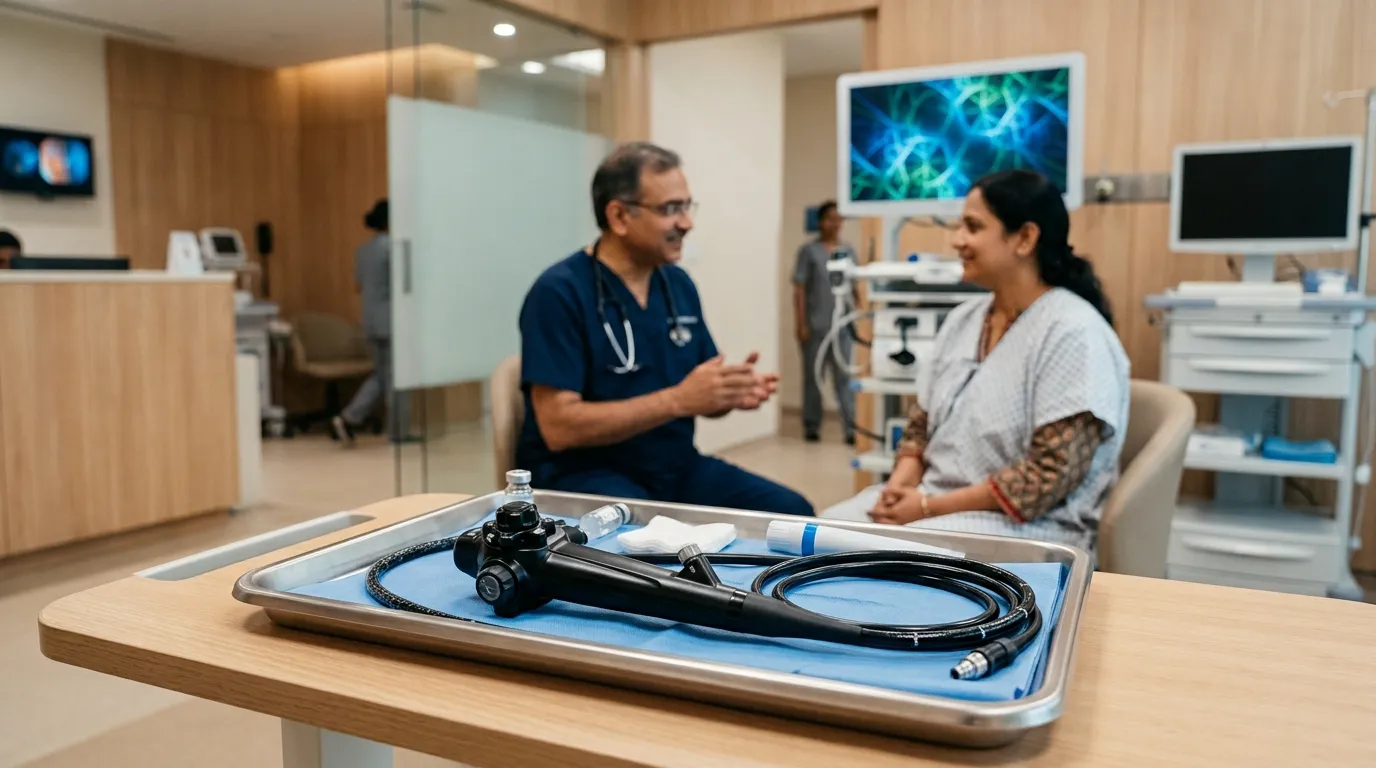
Most people, when they hear the word “endoscopy,” picture one thing, a camera going somewhere it normally wouldn’t, looking for answers. That basic understanding is correct. But what a lot of patients don’t realise is that endoscopy isn’t just about looking. In many cases, the same procedure that finds a problem can also fix it right there, in the same session.
That distinction between an endoscopy done to investigate and one done to treat, is what separates diagnostic from therapeutic endoscopy. It’s not a complicated concept, but understanding it changes how patients think about what they’re actually going in for, what to expect, and what might happen during the procedure.
What Is Endoscopy, to Begin With?
Endoscopy is a procedure where a thin, flexible tube with a camera and light at the tip called an endoscope, is inserted into the body to examine internal structures directly. Unlike an X-ray or a scan, endoscopy gives a real-time, close-up view of the lining of organs and passages.
The endoscope can be passed through the mouth to examine the upper digestive tract, the oesophagus, stomach, and beginning of the small intestine. This is an upper GI endoscopy. It can be passed through the rectum to examine the large intestine, a colonoscopy. It can be passed through the nose to look at the airways a bronchoscopy. Through the urethra to examine the bladder a cystoscopy. The specific type depends entirely on what’s being investigated or treated.
The two broad categories diagnostic and therapeutic apply across all of these, not just upper GI endoscopy.
Diagnostic Endoscopy Looking for Answers
A diagnostic endoscopy is done primarily to investigate. Something is causing symptoms persistent abdominal pain, unexplained bleeding, difficulty swallowing, changes in bowel habit and the endoscopy is being done to understand what’s behind those symptoms.
The procedure gives the doctor a direct visual assessment of the organ lining. What’s seen on that camera tells the clinician things that blood tests, ultrasounds, and CT scans often can’t subtle changes in the mucosal lining, early ulceration, inflammation patterns, abnormal tissue that doesn’t look right.
In many diagnostic endoscopies, a biopsy is taken. This is where a tiny instrument passed through the endoscope snips a small piece of tissue from the area of concern. The patient doesn’t feel this, it’s done through the endoscope while the patient is under sedation. That tissue sample is sent to a pathology lab where it’s examined under a microscope, giving a definitive answer about what the tissue is and whether there are any cellular changes worth knowing about.
A diagnostic endoscopy might be done to investigate:
- Persistent acid reflux or heartburn not responding to medication
- Unexplained upper abdominal pain
- Difficulty or pain when swallowing
- Unexplained nausea or vomiting
- Blood in the stool or black, tarry stools
- Unintentional weight loss with digestive symptoms
- Anaemia without a clear cause
- Screening for conditions like Barrett’s oesophagus in patients with long-standing reflux
- Changes in bowel habit or rectal bleeding, in which case a colonoscopy is the relevant investigation
The outcome of a diagnostic endoscopy is information. A report, findings, sometimes biopsy results that come back a few days later. Treatment decisions are made based on what’s found.
Therapeutic Endoscopy Treating While Looking
A therapeutic endoscopy goes further. It’s not just examining, it’s actively doing something to treat a condition that’s been found. The same endoscope that carries the camera also carries instruments through its working channel forceps, snares, injectors, clips, balloons that allow the surgeon or gastroenterologist to intervene directly.
This is where endoscopy becomes genuinely remarkable. Conditions that once required open surgery or at least a separate procedure after the diagnosis, can now be treated during the same session as the investigation. The patient goes under sedation once, the problem is found and addressed, and they wake up with both answers and treatment done.
Therapeutic endoscopy is used for a wide range of situations:
Stopping Bleeding
One of the most significant applications. When bleeding is found in the upper or lower digestive tract from an ulcer, a torn vessel, a polyp that’s been removed, the bleeding can be controlled endoscopically without surgery. This is done through:
- Injection therapy – a solution is injected around the bleeding point to constrict blood vessels and stop the flow
- Thermal coagulation – heat is applied to seal the bleeding vessel
- Clipping – small metal clips are deployed through the endoscope to close a bleeding vessel, much like a surgical clip
For patients who come in with acute upper GI bleeding, endoscopic treatment often avoids the need for emergency surgery entirely.
Removing Polyps
Polyps abnormal growths on the inner lining of the digestive tract are found during endoscopic examination, particularly colonoscopy. When found, they can usually be removed during the same procedure. This is called polypectomy.
A small snare a wire loop is passed through the endoscope and around the polyp. Electrical current is applied to cut through the stalk and seal the base simultaneously. The polyp is retrieved and sent to pathology. The whole thing happens while the patient is sedated and takes minutes per polyp.
Removing polyps before they have the chance to develop into cancer is one of the most important preventive applications of therapeutic endoscopy.
Dilating Strictures
A stricture is a narrowing in the digestive tract often from scarring caused by chronic acid damage, a healed ulcer, or previous surgery. When a stricture narrows the oesophagus enough to cause difficulty swallowing, it can be widened endoscopically.
A balloon dilator or a series of graduated dilators is passed through the endoscope to gently stretch and widen the narrowed segment. The procedure can significantly improve swallowing in patients with oesophageal strictures, sometimes in a single session, sometimes requiring a few repeat sessions over time.
Removing Foreign Bodies
Particularly relevant in children who swallow small objects, or in adults where food boluses or objects become stuck in the oesophagus. Endoscopy allows direct retrieval using grasping forceps or retrieval nets passed through the working channel avoiding surgery in most cases.
Placing Stents
When a tumour or other condition is causing a significant narrowing or obstruction in the oesophagus, stomach, bile duct, or colon, a stent, a small expandable tube, can be placed endoscopically to keep the passage open. This is particularly used in patients with advanced cancers where surgery isn’t possible, allowing them to eat and maintain nutrition while other treatment continues.
Endoscopic Mucosal Resection (EMR) and Endoscopic Submucosal Dissection (ESD)
These are more advanced endoscopic techniques used to remove larger areas of abnormal or early cancerous tissue from the mucosal lining without surgery. EMR lifts and removes a flat lesion using a snare. ESD uses specialised knives to dissect beneath the lesion and remove it as a single piece. Both allow treatment of early-stage mucosal cancers that would previously have required surgical resection.
Managing Achalasia
Achalasia is a condition where the lower oesophageal sphincter fails to relax properly, trapping food above it. Endoscopic treatment options include pneumatic dilation balloon dilation of the sphincte and a newer technique called POEM (peroral endoscopic myotomy), where the sphincter muscle is cut from the inside using an endoscopic approach. Both avoid open surgery.
Bile Duct Procedures ERCP
ERCP endoscopic retrograde cholangiopancreatography is a specialised endoscopic procedure that examines and treats conditions affecting the bile duct and pancreatic duct. It combines endoscopy with X-ray guidance.
Through ERCP, a surgeon can:
- Remove gallstones that have migrated into the bile duct
- Place stents in narrowed or blocked bile ducts
- Drain bile duct obstructions caused by tumours
- Take biopsies from the bile duct
ERCP is one of the more complex endoscopic procedures and is performed by specialists, but it illustrates just how far therapeutic endoscopy has extended into territory that was once exclusively surgical.
Can One Endoscopy Be Both Diagnostic and Therapeutic?
Absolutely and this is very common. A procedure that starts as diagnostic can become therapeutic within the same session.
A patient comes in for an upper GI endoscopy to investigate reflux symptoms. During the examination, a small polyp is found in the stomach. The surgeon removes it then and there, sends it to pathology, and the patient wakes up having had both investigation and treatment in one go.
Or a colonoscopy is done to investigate rectal bleeding. A bleeding point is found and clipped during the same examination. Or multiple polyps are found and all removed before the patient leaves the procedure room.
This is one of the most practically valuable aspects of modern endoscopy, it collapses what could be two separate procedures into one, reduces the time to treatment, and avoids the patient needing to go through preparation and sedation twice.
What Should Patients Expect?
Whether the endoscopy is diagnostic, therapeutic, or both, the patient experience on the day is largely the same. Fasting beforehand, a pre-procedure check, sedation administered through a cannula, the procedure itself, usually fifteen to forty-five minutes depending on complexity and then recovery in a monitored area as the sedation wears off.
Therapeutic procedures may take slightly longer than purely diagnostic ones, and there may be slightly more post-procedure instructions depending on what was done dietary restrictions after a dilation, for example, or activity limitations after a larger polypectomy.
Biopsy results, if taken, typically return within a few days. Findings from the procedure itself are usually discussed with the patient before they leave.
Final Thoughts
Endoscopy has evolved well beyond a camera on a tube. It’s now a platform for investigation and treatment that handles conditions ranging from a bleeding ulcer to early mucosal cancer often in a single, well-tolerated procedure under sedation.
Understanding that your endoscopy might do more than just look, and knowing what “therapeutic” actually means in practice, makes the whole experience less uncertain going in.
Our team performs both diagnostic and therapeutic endoscopic procedures, guiding patients through what to expect before, during, and after. If you’ve been advised to have an endoscopy and want to understand exactly what that involves for your situation, come in for a consultation, the clearer the picture going in, the more straightforward the experience tends to be.